When an office equipped with non-PoE switches requires new IP cameras and phones, trying to fill the need with similar equipment might prove both costly and impractical. Investing in a complete Power over Ethernet (PoE) overhaul may seem out of reach, budget-wise, but delaying modernization also slows down your operations.
The good news is that upgrading a network with PoE doesn’t require a total rebuild. PoE injectors solve this problem. They allow you to add Power over Ethernet—instantly and cost-effectively—to any existing network, with no major rebuild or cabling changes required. PoE injectors bridge the gap between legacy 100 Mbps switches and modern PoE endpoints, delivering standards-compliant power over existing cables. They can be deployed in hours at minimal cost per device.
What is a PoE injector?
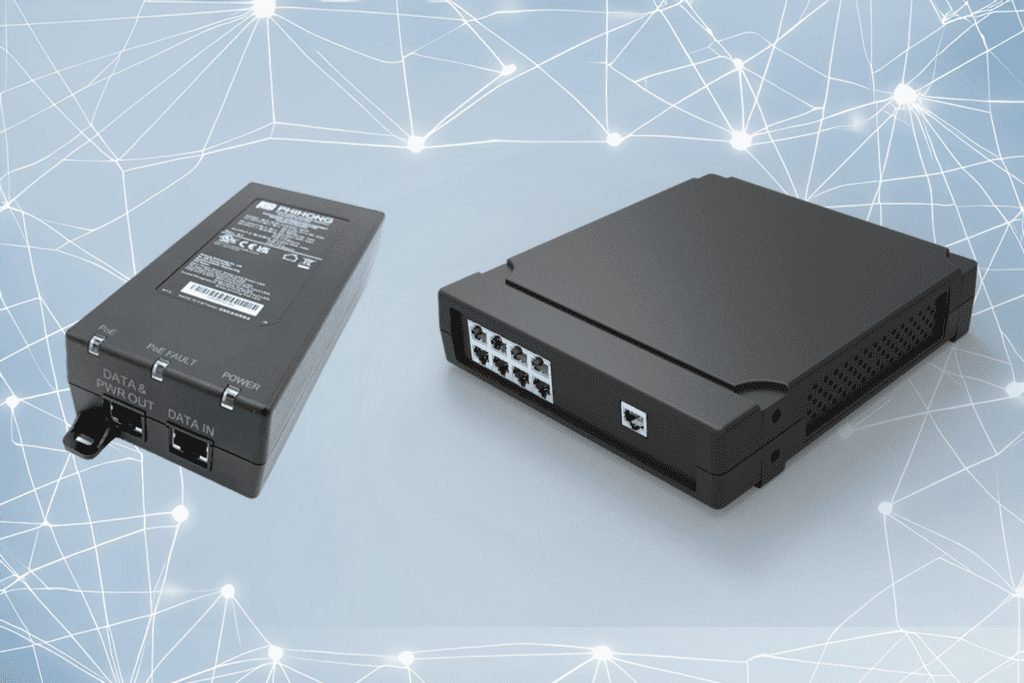
A PoE injector is a device that adds Power over Ethernet capability to a standard, non-PoE network connection. Essentially an external power supply that sits between a legacy network switch and a PoE-enabled device, it injects electrical power into an Ethernet cable that is already carrying a data signal.
The PoE injector has three main connection points:
- AC power input: Plugging into a standard wall outlet, a PoE injector converts AC power to DC power as required by the PoE standard.
- Data IN port: A standard Ethernet cable connects to the non-PoE network, the data source.
- Data OUT port: Connects to a powered device such as an IP camera or VoIP phone via Ethernet cable.
Single-port injectors are essentially plug-and-play devices that can deliver power to one endpoint. Multi-port injectors can power several devices simultaneously.
The Top 5 Benefits of PoE Injectors in Mixed Environments
The benefits of using PoE injectors in networks that are a mix of legacy equipment and modern PoE devices include cost savings, flexibility, and streamlined, non-disruptive deployment.
1. Cost Efficiency
PoE injectors are the most cost-effective way to add PoE capability to an existing network without replacing a non-PoE switch. New PoE devices can be powered using existing non-PoE network switch infrastructure, saving the expense of a full switch upgrade. The life of older switches can be extended by 3 to 5 years with the addition of a PoE injector.
2. Granular Deployment
PoE injectors enable granular deployment, one device at a time. PoE-enabled devices can be added as needed without a significant infrastructure overhaul. This prevents over-investing in a larger PoE power budget than required.
3. Rapid, Nondisruptive Deployment
Network downtime is minimized with PoE injectors, which provide a plug-and-play solution for incorporating PoE into a network with near-zero disruption. PoE injectors can be mounted underneath a desk, on a ceiling, or on a DIN rail in under three minutes per injector.
4. Future-Proofing without Recabling
If your future devices require more power, simply replace the existing injector with a higher-wattage model—no new cabling or switch replacement necessary. Incremental upgrades allow a pay-as-you-grow solution for targeted growth.
5. Centralized Power Management
Managed multi-port injectors offer a centralized power management solution for those networks with a larger number of devices that still don’t warrant a full PoE switch. Protocols like SNMP/HTTP support remote reboot and per-port metering.
UPS (Uninterruptible Power Supply) integration provides centralized emergency backup.
How to Choose the Right PoE Injector
Choosing the right injector depends on the power needs of your device.
- Type 1 PoE or Type 2 PoE+ injectors supply sufficient power for low-voltage access points (APs) and VoIP phones that require 15W to 30W.
- Type 3 PoE++ injectors are adequate for higher-power APs and mounted PTZ cameras that need as much as 60W to operate.
- Type 4 PoE++ injectors supply up to 90W of power, enough for more power-hungry devices like digital signage and interactive kiosks.
The injector IEEE class, such as 802.3at, must be matched to the device. PoE+ and PoE++ will power devices of an equal standard and lower.
PoE Injector Installation
Installing a PoE injector should take less than 15 minutes.
- Verify the cable. Cat 5e or better should be sufficient.
- Mount the injector using Velcro beneath a desk, a zip-tie on the ceiling, or appropriate fasteners/clips for a DIN rail.
- Set up the connections. The existing switch plugs into the injector at DATA IN; the injector plugs into the endpoint device via PoE OUT; the injector AC cord plugs into the nearest outlet. UPS is preferable for critical applications.
To prevent damage to incompatible devices, PoE injectors use a handshake protocol to negotiate power. A PoE injector will automatically negotiate the correct wattage using IEEE handshake protocols, ensuring it will not damage a lower-power device.
When to Graduate From Injectors to PoE Switches
There may come a point in your network evolution when PoE injectors are no longer the best choice for your operation. If 70% of ports require PoE power, it’s a good time to move to a PoE switch. A 10GbE backbone would also warrant an upgrade to a PoE switch.
When upgrading to PoE switches, PoE injectors should be kept as a backup for overflow or remote drops.
PoE Injectors: the Fastest Way to Modernize Any Network
PoE injectors offer an innovative, cost-effective solution for integrating modern IP cameras and VoIP phones into a legacy network without the expense of a complete network overhaul. A PoE injector converts AC wall power to DC and injects it onto the data signal. The gap between legacy non-PoE switches and modern PoE-enabled devices is bridged by introducing IEEE-compliant power over existing Ethernet cabling.
The top benefits of incorporating a PoE injector include:
- Cost Savings from extending the life of older switches or delaying the purchase of a more expensive PoE switch
- Granular Deployment for incremental, pay-as-you-grow scaling
- Plug-and-Play Setup for speedy deployments with minimal downtime
- Centralized Power Management with multi-port injectors for remote reboot capabilities and UPS integration in larger deployments
Selection is the key to a successful PoE integration via an injector. Ensure the injector’s standard (IEEE 802.3af/at/bt) matches the device’s power requirements.
Begin Your PoE Journey
The best network upgrades are the ones your budget doesn’t notice. Start by identifying ten endpoints that need PoE, then deploy injectors to bridge your legacy switches with modern devices.
If you’re ready to experience the freedom that PoE offers, contact Planet Technology USA today. Our solutions help future-proof your network while saving you money.