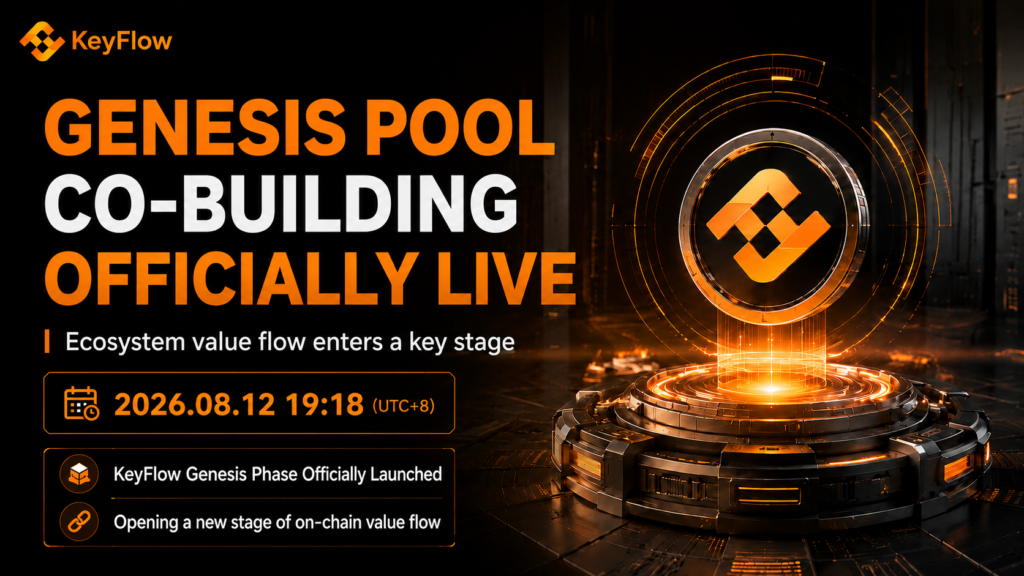
KeyFlow has officially launched its Genesis Pool Co-Building program, marking a major step in the development of its AI-focused value settlement ecosystem. The Genesis Pool went live at 19:18 on August 12, 2026, UTC+8, introducing a new participation model designed around AI computing resources, liquidity, and ecosystem value circulation.
Built on the AI infrastructure provided by UniKey, KeyFlow aims to connect AI capabilities with an on-chain settlement framework. Its new model combines early participation incentives with 360-day Intelligent Computing LP Orders to establish an initial liquidity treasury for the ecosystem.
As AI models and Agent applications continue to expand globally, access to computing resources and AI services has become increasingly important for developers, businesses, and individual users. At the same time, the cost and complexity associated with computing power can create barriers for smaller participants.
KeyFlow says its objective is to reduce those barriers by creating a settlement network focused on the emerging AI Agent economy.
KeyFlow Introduces a New AI Value Settlement Model
The Genesis Pool represents KeyFlow’s latest effort to create a structured connection between AI usage and ecosystem value.
The platform is designed to transform AI-related activities, including service usage, API calls, and computing resource leasing, into measurable economic activity within its settlement network.
According to KeyFlow, this approach is intended to create a more complete value cycle. AI capabilities are provided through UniKey, while KeyFlow focuses on the settlement, circulation, and liquidity mechanisms surrounding the ecosystem.
The result is a dual-layer structure in which technology and value settlement operate together.
UniKey and KeyFlow Form a Dual-Core Ecosystem
The relationship between UniKey and KeyFlow is built around two primary functions: AI capability and value settlement.
UniKey as the Capability Layer
UniKey serves as the AI infrastructure layer of the ecosystem. It brings together access to different AI models, computing resources, and workflow capabilities through a unified environment.
The platform is designed for the Agent era, where AI applications increasingly need access to multiple models and computing resources.
By providing a unified AI usage network, UniKey seeks to simplify the process for users and developers who need different AI capabilities for their applications and workflows.
KeyFlow as the Value Settlement Hub
KeyFlow operates as the settlement layer connected to the UniKey ecosystem.
Its framework is centered around KEY and is designed to cover several stages of ecosystem value circulation, including capital inflow, token issuance, business-related revenue mechanisms, and market liquidity management.
KeyFlow states that revenue generated through AI services, API calls, and computing-power leasing can contribute to its broader KEY buyback and burn mechanism.
The intended result is a value cycle connecting AI usage with token-based ecosystem activity.
Genesis Pool Opens a New Participation Model
The Genesis Pool was introduced to establish an initial liquidity foundation for the KeyFlow settlement network.
At the center of the program is a 360-day Intelligent Computing LP Order mechanism.
Participants who enter the Genesis Pool have their contributions converted through smart contracts into these LP Orders. The orders are then allocated to the ecosystem liquidity treasury.
According to KeyFlow, the structure is intended to provide a foundation for the platform’s longer-term operations while establishing a scheduled settlement process for participants.
As with any blockchain-based financial mechanism, participants should independently review the smart contracts, terms, risks, and economics before committing funds.
360-Day Intelligent Computing LP Orders
The 360-day LP Order structure is designed around a scheduled settlement period.
Rather than treating participation as a simple short-term transaction, KeyFlow positions the mechanism as a longer-term contribution to the ecosystem’s liquidity infrastructure.
Settlement is connected to the blockchain’s block-based accounting system. The generated principal and returns are released progressively according to the platform’s settlement mechanism.
KeyFlow says participants can withdraw available amounts on a daily basis. They may also choose to re-enter available funds into the ecosystem according to their individual participation strategy.
The model is intended to combine predictable settlement with continuous liquidity participation.
Early-Bird Pricing Creates a Step-Up Structure
One of the central features of the Genesis Pool is its early-bird conversion mechanism.
The program provides participants with an initial discount that changes over time.
For participants entering during the first day, KeyFlow states that the settlement price carries a 35% discount.
For example, under the stated conversion model, a contribution of 100 USDT would correspond to approximately 153.8 USDT worth of KEY allocation.
This is based on the calculation:
100 ÷ 0.65 ≈ 153.8
The stated pricing mechanism is designed to reward earlier participation.
Daily Step-Up in Settlement Cost
Following the initial participation period, the discount level changes every 24 hours.
KeyFlow states that the discount adjustment increases by 0.005 each day, resulting in a progressively higher settlement cost over time.
This creates a straightforward early-participant incentive.
Those who participate earlier receive the benefit of the lower initial settlement price, while later participants enter under progressively adjusted conditions.
Participants should review the live terms and smart contract before relying on any specific conversion amount, as blockchain program parameters can change.
Routing Nodes Expand the Network
Alongside the Genesis Pool, KeyFlow has introduced a routing-node structure designed to expand its distributed ecosystem.
An account can reportedly become an active routing node through a 100 USDT contribution.
The routing system is intended to support ecosystem promotion, network collaboration, and the distribution of AI-related computing resources.
As the network expands, KeyFlow plans to use different participation levels to provide additional responsibilities and potential ecosystem benefits.
Three Core Routing Levels
KeyFlow has established three primary participation tiers for capital and community partners.
A1 Routing Level
Participants reaching the 1,000 USDT tier can qualify for the A1 routing level.
The A1 level is positioned as an entry-level service-provider node qualification.
Participants at this level can participate in the network’s basic node structure and may receive referral revenue sharing associated with qualifying network activity.
A2 Routing Level
The 5,000 USDT tier provides access to the A2 routing level.
According to KeyFlow, this level is designed to provide expanded agency and distribution support for computing-power tokens.
It also provides participants with access to the underlying computing-power monetization channel within the ecosystem.
A3 Routing Level
The highest announced tier requires 10,000 USDT.
Participants reaching this level can qualify for the A3 routing level and receive enhanced agency rights for computing-power tokens.
KeyFlow also states that A3 participants will be eligible for long-term revenue-sharing rights associated with 20% of network-wide SWAP fees.
These participation structures represent important components of KeyFlow’s proposed ecosystem model. Users should carefully evaluate the eligibility conditions, contractual terms, and financial risks before participating.
Connecting AI Usage With Ecosystem Value
The broader vision behind KeyFlow is to establish a connection between real AI usage and blockchain-based value settlement.
AI services increasingly depend on computing resources. Developers use large language models, image-generation systems, AI Agents, APIs, and other infrastructure to build products and automate workflows.
Each of these activities can generate measurable usage.
KeyFlow seeks to create an economic layer around this activity.
Under the proposed model, AI capabilities are supplied through UniKey while KeyFlow handles the settlement and liquidity side of the ecosystem.
This creates a structure in which AI infrastructure and blockchain settlement are designed to complement each other.
A Focus on the Emerging AI Agent Economy
The growth of AI Agents is creating new requirements for infrastructure.
Unlike traditional software applications, AI Agents can interact with multiple models, APIs, tools, databases, and computing environments.
As these systems become more capable, demand for reliable computing resources and AI services is expected to grow.
KeyFlow positions its settlement network as part of this emerging infrastructure.
The project’s goal is to make participation in the AI value economy more accessible while creating mechanisms for the movement of value generated through AI-related services.
Creating a Broader Liquidity Network
Liquidity is an important component of blockchain ecosystems.
A network needs sufficient liquidity to support transactions, token exchanges, and other economic activities.
KeyFlow’s Genesis Pool is designed to provide an initial liquidity foundation while simultaneously creating a structured participation mechanism.
The 360-day Intelligent Computing LP Orders are intended to support this foundation over an extended period.
By combining liquidity participation with AI-related ecosystem activity, KeyFlow aims to develop a settlement network that can scale alongside demand for AI infrastructure.
The Role of KEY in the Ecosystem
KEY is positioned as the central token connecting different parts of the KeyFlow ecosystem.
The platform describes KEY as a link between AI computing resources and application services.
Its proposed economic model includes token issuance, ecosystem circulation, revenue mechanisms, and buyback and burn activity.
The purpose of these mechanisms is to create a connection between ecosystem usage and token economics.
Whether such mechanisms achieve their intended economic outcomes will depend on actual platform adoption, transaction activity, liquidity, execution, and broader market conditions.
From AI Capability to Value Settlement
The KeyFlow ecosystem can be viewed as a sequence of connected layers.
UniKey provides access to AI capabilities and computing resources.
Applications and users generate AI-related activity through those capabilities.
KeyFlow provides the proposed settlement and liquidity infrastructure around that activity.
KEY acts as the central token within the ecosystem’s economic framework.
This structure is intended to turn AI usage into an ecosystem value flow that can be recorded, settled, and recycled.
Why the Genesis Pool Matters
The Genesis Pool is more than a new participation program for KeyFlow.
It represents the project’s attempt to establish the financial infrastructure needed for its broader ecosystem vision.
Launching the Genesis Pool allows KeyFlow to begin building its initial liquidity treasury while simultaneously introducing its routing-node network.
It also gives early participants a defined mechanism through which they can engage with the ecosystem.
The success of this model, however, will ultimately depend on adoption and real economic activity rather than participation alone.
Lowering the Barrier to AI Ecosystem Participation
One of KeyFlow’s stated objectives is to make participation in the AI economy more accessible.
AI infrastructure has historically required significant technical knowledge and financial resources.
Large-scale computing resources can also be expensive, particularly for independent developers and smaller businesses.
By combining AI infrastructure with a blockchain-based participation model, KeyFlow is attempting to create an alternative pathway into the AI Agent economy.
The long-term effectiveness of this approach will depend on how successfully the platform attracts users, developers, service providers, and ecosystem partners.
A New Chapter for AI and Blockchain Integration
The launch of KeyFlow’s Genesis Pool reflects the growing convergence between artificial intelligence and blockchain technology.
AI provides computational capabilities and intelligent services, while blockchain can provide transparent records, programmable transactions, and token-based settlement systems.
Combining these technologies could create new economic models for computing resources and AI applications.
KeyFlow is positioning itself within this intersection by focusing specifically on value settlement.
Its connection with UniKey provides the foundation for its AI infrastructure strategy, while the KeyFlow network focuses on economic circulation.
KeyFlow’s Vision for the Future
KeyFlow describes its long-term objective as building a settlement network capable of supporting the growing intelligent agent economy.
The project envisions a system in which AI computing power, application services, tokenized value, liquidity, and network participants operate within a connected ecosystem.
The Genesis Pool represents the initial stage of this strategy.
Its early-bird conversion system, 360-day LP Orders, routing nodes, and tiered participation structure are intended to establish the foundations for future network growth.
As adoption increases, the platform will need to demonstrate sustainable real-world usage and transparent economic performance to support its broader vision.
Official Genesis Pool Launch
KeyFlow officially launched its Genesis Pool Co-Building program at 19:18 on August 12, 2026, UTC+8.
The launch brings together the project’s AI infrastructure strategy, liquidity framework, routing network, and token-based settlement model.
Through its relationship with UniKey, KeyFlow aims to build a bridge between AI capabilities and ecosystem value settlement.
The project is now inviting users, developers, community members, and potential ecosystem partners to explore its platform and learn more about its evolving network.
Looking Ahead
The rapid development of AI Agents is creating demand for new infrastructure, computing resources, and economic models.
KeyFlow is attempting to address this opportunity by combining AI infrastructure with blockchain-based settlement.
The Genesis Pool marks an important milestone in that strategy.
By introducing early participation incentives, 360-day Intelligent Computing LP Orders, routing nodes, and a multi-level ecosystem structure, KeyFlow aims to create the foundation for a distributed AI value network.
Its ultimate success will depend on sustained AI usage, genuine ecosystem adoption, transparent execution, and the ability to create lasting value for participants.
For those interested in exploring the project, KeyFlow’s official DApp is available at https://www.getkeyflow.ai.
As the AI Agent economy continues to develop, the integration of computing power, AI applications, and decentralized value settlement could become an increasingly important area of innovation. KeyFlow’s Genesis Pool represents its latest step toward participating in that emerging market.
