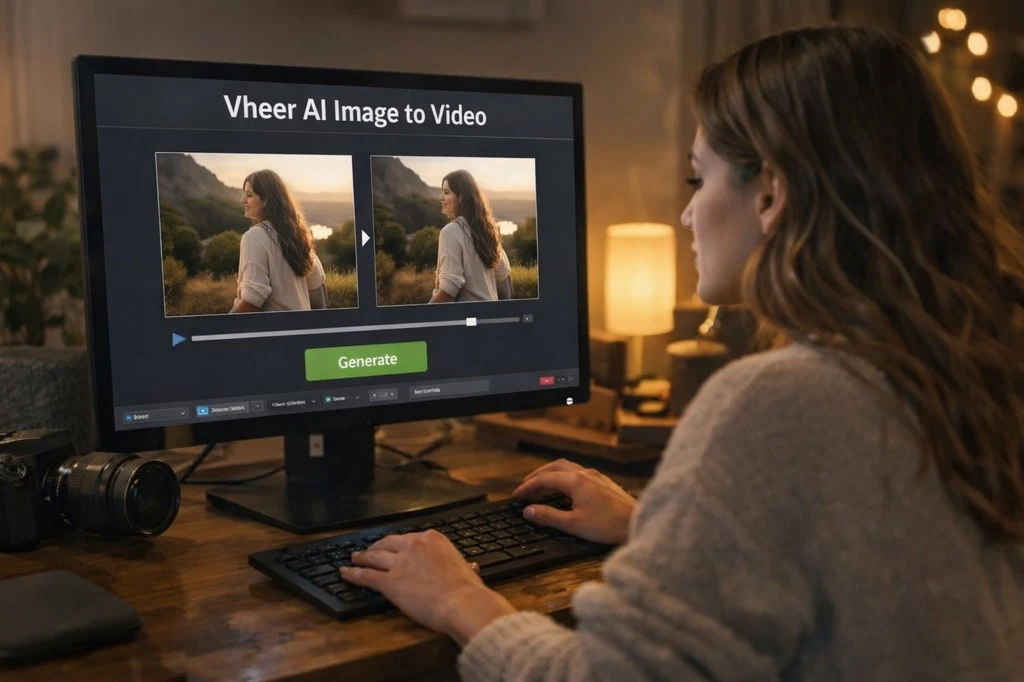
In the modern era of visual storytelling, the ability to breathe life into static imagery is an essential skill for any digital creator. Whether you are a social media influencer, a marketing professional, or a concept artist, the time required to manually animate scenes can often be the largest bottleneck in your production pipeline. Enter vheer, a sophisticated platform designed to simplify the synthesis of cinematic motion from simple visual inputs. By automating the technical complexities of frame-by-frame animation, this utility allows users to focus on narrative and aesthetic goals rather than spending days on frame interpolation.
The core technology powering the platform relies on advanced temporal consistency modeling. When you provide a source image, the system constructs a spatial coordinate grid that maps foreground subjects against the background. It calculates depth variables, lighting reflections, and material textures to create an environment that feels three-dimensional. Once this spatial awareness is established, the motion synthesis engine tracks how individual pixel clusters move across the timeline, producing a logical and fluid result that retains the original visual quality of your input.
For independent content creators, the primary benefit is speed. Traditional animation workflows—which often necessitate complex rigging or expensive motion-capture hardware—are now replaced by efficient, browser-based synthesis. You can take a single, well-composed photograph and turn it into a looping clip, a dynamic transition, or a short cinematic sequence without needing deep technical knowledge of animation curves or easing functions. This lowers the barrier to entry, enabling hobbyists and professionals alike to produce high-impact motion content rapidly.
Professional branding agencies also stand to gain significantly from this streamlined approach. In an environment where social media engagement is dictated by video performance, having the ability to generate subtle, high-quality motion assets for brand headers or product showcases provides a distinct marketing advantage. A static image of a product can easily be turned into a sequence showing realistic light reflections or ambient movement, which drastically improves user attention and interaction rates on busy platforms.
Consistency is often the main challenge in generative video, yet the platform addresses this with robust spatial tracking. By maintaining a constant structural reference to your initial image, it prevents the common visual artifacts—such as “ghosting” or distorted geometry—that often ruin AI-generated clips. This makes the output reliable enough for professional projects, whether you are building a commercial website background or preparing content for a client presentation.
Finally, the platform’s accessibility is a key driver for its growing popularity. By operating within the browser, it removes the need for hardware-intensive rendering local clusters. This decentralizes the production studio, allowing you to synthesize motion assets while working from a standard laptop or tablet. As you continue to explore the platform’s potential, you will find that the consistency of the motion, combined with the ease of prompt management, makes it an essential part of a modern creative’s workflow.
